
SEO is no longer just about keywords, backlinks, and rankings. It is evolving into something far more intelligent—a conversation between humans and data.
With its latest update, Google has quietly introduced one of the most transformative features in recent years: AI-powered configuration inside Google Search Console (GSC). This update allows users to generate performance reports simply by describing what they want to see.
This is not just a UI improvement. It signals a deeper shift in how search data will be analyzed, interpreted, and acted upon.
For a modern, performance-driven agency like Ikigai Clicks, this is exactly the kind of evolution we build our strategies around.
Table of Contents
Understanding the Google Search Console 2026 Update
Google Search Console has always been a core tool for SEO professionals. It provides direct insights into how a website performs in Google Search—covering impressions, clicks, click-through rate (CTR), and average position.
However, until now, extracting meaningful insights required:
- Manual filtering
- Data segmentation
- Technical understanding of search queries
The 2026 update changes that.
Key Additions in the Update
1. Customizable Performance Reports
Users can now:
- Apply multiple filters seamlessly
- Customize views based on queries, pages, countries, and devices
- Save report configurations for repeated analysis
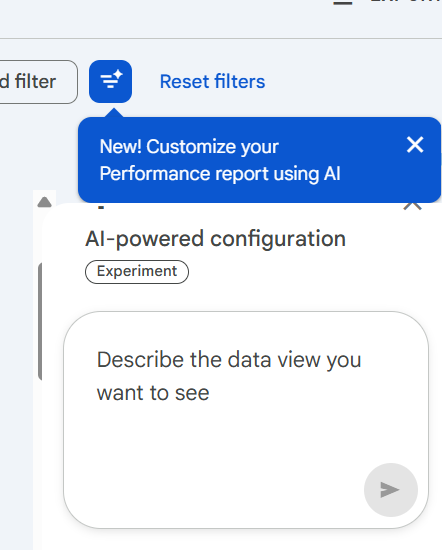
2. AI-Powered Configuration (Experimental Feature)
This is where the real shift happens.
Instead of manually configuring filters, users can now:
- Type a question or instruction
- Let Google generate a tailored report
For example:
- “Show traffic from UAE in the last 30 days”
- “Compare mobile vs desktop CTR performance”
- “Which pages lost ranking this month?”
Google processes these prompts using AI and instantly presents relevant data.

The Shift from Manual SEO to Conversational SEO
This update represents a transition from:
👉 Tool-based SEO → AI-assisted SEO
Earlier:
- You needed to know how to extract data
Now:
- You just need to know what to ask
This is a major evolution in digital marketing.
It aligns with broader trends like:
- AI search experiences
- Natural language interfaces
- Predictive analytics
SEO is no longer a technical barrier—it’s becoming a strategic thinking process.
Why This Update Matters More Than It Seems
At first glance, this might look like a simple feature addition. But in reality, it changes three fundamental aspects of SEO:
1. Speed of Insight
Marketers can now:
- Generate reports in seconds
- Skip repetitive manual tasks
This increases agility in campaigns.
2. Depth of Analysis
AI enables:
- Complex data combinations
- Multi-layered insights
For example:
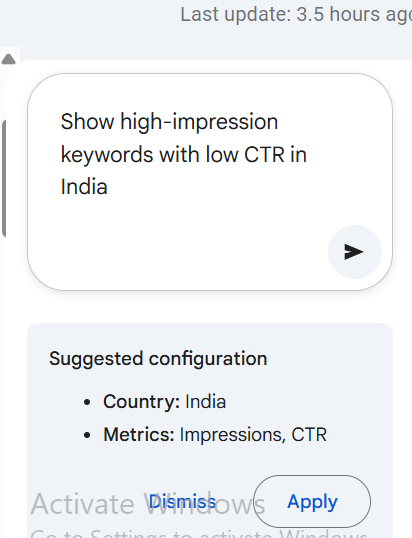
Instead of checking metrics separately, you can ask:
👉 “Show high-impression keywords with low CTR in India”
3. Accessibility
Even non-technical users can:
- Understand SEO data
- Make informed decisions
This democratizes SEO.
Practical AI Prompts That Redefine SEO Workflows
To fully leverage this feature, you need structured thinking. The power lies in asking the right questions.
Traffic Intelligence
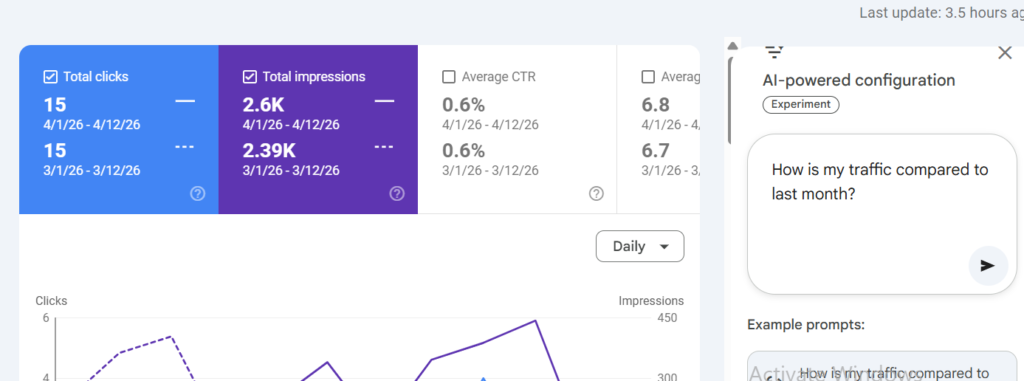
- How is my traffic compared to last month?
- Show total clicks and impressions for the last 90 days
- Identify traffic growth trends for blog pages
Keyword Strategy
- Show queries containing “how to” or “what is”
- Which keywords bring the highest impressions?
- Identify keywords with declining performance
Conversion-Oriented Insights
- Which pages have high clicks but low conversions?
- Show pages with high impressions but low CTR
Geo-Targeting (Critical for Ikigai Markets)
- Show traffic from UAE vs India
- Compare UK and Kerala performance
- Identify top-performing countries
Device Optimization
- Compare mobile vs desktop CTR
- Identify mobile performance issues
Ranking Opportunities
- Which pages are ranking on page 2?
- Show keywords close to top 3 positions
👉 The future of SEO is not just data—it’s question-driven intelligence.
SEO Impact Across India, Kerala, UAE, and the UK
Ikigai Clicks operates in diverse, competitive markets. This update is especially powerful for multi-region SEO strategies.
🇮🇳 India
- Large keyword competition
- AI helps identify niche opportunities
- Faster regional targeting
Kerala
- Local SEO dominance becomes easier
- Analyze Malayalam + English queries
- Improve hyperlocal visibility
🇦🇪 UAE
- Highly competitive industries (healthcare, finance)
- AI helps uncover missed keyword opportunities
- Better tracking of expat-driven search behavior
🇬🇧 UK
- Mature SEO market
- Requires precision and data depth
- AI enables faster strategic adjustments
Ikigai Clicks: A Fully Modern Digital Marketing Approach
At Ikigai Clicks, we are not a traditional digital marketing agency.
We operate at the intersection of:
- AI
- Search behavior
- Conversion science
- Content intelligence
This update perfectly aligns with our philosophy:
👉 SEO is not about ranking—it’s about understanding intent and driving outcomes
How We Use This Update
1. AI-Driven Data Analysis
We use AI prompts to:
- Identify hidden growth opportunities
- Analyze multi-channel performance
2. Search Everywhere Optimization
SEO is no longer limited to Google.
We optimize for:
- Search engines
- AI search results
- Social discovery platforms
3. Topical Authority Building
Using AI insights, we:
- Build content clusters
- Strengthen semantic relevance
- Improve long-term rankings
4. Conversion-Focused SEO
We don’t just track traffic.
We focus on:
- User intent
- Engagement signals
- Conversion pathways
Topical Authority in the Age of AI
Google is increasingly prioritizing topical authority over isolated keyword rankings.
This means:
- Covering topics deeply
- Building interconnected content
- Answering user intent comprehensively
How AI Helps Build Authority
With AI-powered GSC:
- Identify content gaps
- Discover related queries
- Expand topic clusters
Example:
If you rank for:
👉 “medical billing UAE”
AI can help you expand into:
- insurance claims UAE
- revenue cycle management UAE
- healthcare billing errors
This builds authority and improves rankings.
From Data to Decisions: Real SEO Use Cases
Case 1: Low CTR Optimization
Prompt:
👉 “Show keywords with high impressions but low CTR”
Action:
- Improve meta titles
- Add emotional triggers
- Increase clickability
Case 2: Content Expansion
Prompt:
👉 “Show queries containing ‘how to’”
Action:
- Create informational blogs
- Target long-tail keywords
Case 3: Regional Growth
Prompt:
👉 “Compare UAE vs India traffic”
Action:
- Localize content
- Adjust targeting strategy
Semantic SEO and AI Integration
Modern SEO is not keyword stuffing.
It’s about:
- Context
- Meaning
- Relationships between topics
Semantic Keywords in This Context
- search analytics tools
- organic traffic growth
- click-through rate optimization
- ranking position analysis
- AI SEO tools
- performance tracking systems
AI helps connect these naturally within content.
The Future of SEO: What This Update Signals
This is just the beginning.
We can expect:
- Fully automated SEO insights
- Predictive performance analysis
- AI-generated optimization suggestions
Eventually:
👉 SEO tools will tell you what to do, not just what happened
Conclusion: The New Era of AI-Driven SEO
The Google Search Console 2026 update is more than a feature—it’s a signal.
A signal that:
- SEO is becoming intelligent
- Data is becoming conversational
- Strategy is becoming faster
For businesses, this means:
👉 Adapt early or fall behind
For agencies like Ikigai Clicks, this is an opportunity to lead.
FAQ
What’s new in Google Search Console (2026)?
The latest Google Search Console update introduces AI-powered configuration, allowing users to create performance reports using natural language prompts instead of manual filters. This feature helps marketers quickly analyze clicks, impressions, CTR, and ranking positions with minimal effort.
Other updates include improved report customization, smarter filtering options, and better data segmentation across countries, devices, and search queries. These enhancements make SEO analysis faster, more intuitive, and accessible even for beginners while supporting advanced strategies for professionals.
❓ How can I get Google Search updates?
To stay updated with Google Search changes, follow official and trusted sources. The best way is to regularly check the Google Search Central Blog, where Google announces algorithm updates, feature releases, and SEO guidelines.
You can also follow Google Search Console notifications, subscribe to SEO newsletters, and monitor industry platforms. For marketers, using tools like Search Console itself helps identify ranking fluctuations, traffic changes, and indexing issues in real time.
❓ How do I update the latest version of Google?
Google Search itself updates automatically, so users don’t need to manually install updates. However, if you are referring to Google Chrome or mobile apps, you can update them through your device’s app store or browser settings.
For SEO tools like Google Search Console, updates are applied automatically by Google. To access new features, simply log in to your account and explore the latest interface or experimental tools available.
❓ How long does Google Search Console take to update?
Google Search Console data is not real-time. Typically, it takes 24 to 48 hours for performance data such as clicks, impressions, and rankings to update.
However, indexing updates may take longer depending on crawl frequency, website authority, and content changes. For accurate analysis, it is recommended to review data over a period of days or weeks rather than relying on single-day metrics.
❓ What is the Google update in 2026 for SEO?
The 2026 Google update focuses heavily on AI integration, user intent, and content quality. With features like AI-powered reporting in Search Console and AI-generated search results (AI Overviews), Google is prioritizing meaningful, helpful, and context-rich content.
SEO in 2026 is less about keywords alone and more about:
- Topical authority
- Search intent matching
- User experience
- Content depth and relevance
❓ Is SEO dead or evolving in 2026?
SEO is not dead—it is evolving rapidly.
In 2026, SEO has shifted from traditional keyword optimization to AI-driven, intent-based optimization. Search engines now understand context, meaning, and user behavior more deeply.
Modern SEO focuses on:
- High-quality content
- Semantic relevance
- User engagement
- Multi-platform visibility
Businesses that adapt to these changes will continue to grow, while outdated strategies will lose effectiveness.
❓ What will Google do in 2026?
Google is moving towards a fully AI-powered search ecosystem. This includes:
- AI-generated search summaries (AI Overviews)
- Conversational search experiences
- Smarter ranking algorithms
- Integration of AI across tools like Search Console
The goal is to provide faster, more accurate, and more helpful answers to users, reducing the need for manual searching.
❓ What is the most searched thing on Google in 2026?
Search trends in 2026 are influenced by AI, real-time events, and user intent. Popular searches typically include:
- AI tools and technologies
- Health and finance queries
- Local services and businesses
- “How-to” and informational content
The exact most searched topic changes frequently, but informational and problem-solving queries remain dominant in search behavior.
❓ How can I check my SEO ranking?
You can check your SEO ranking using Google Search Console. It shows your website’s average position for specific keywords along with clicks and impressions.
To check rankings:
- Go to Performance report
- Select queries or pages
- Analyze average position
You can also use SEO tools for deeper insights, but Search Console provides the most accurate data directly from Google.
❓ How do I get Google Search Console?
To access Google Search Console:
- Visit the official Search Console website
- Sign in with your Google account
- Add your website property
- Verify ownership (via DNS, HTML file, or tag)
Once verified, you can start tracking your website’s performance in Google Search.
❓ Is Google Search Console an SEO tool?
Yes, Google Search Console is one of the most important SEO tools.
It helps you:
- Monitor website performance
- Track keyword rankings
- Identify indexing issues
- Improve search visibility
Unlike third-party tools, it provides direct data from Google, making it highly reliable for SEO analysis.
❓ How do I open Google Search Console?
To open Google Search Console:
- Go to the official website
- Log in using your Google account
- Select your website property
If your website is already verified, you can immediately access reports, insights, and performance data.
Written by Shinsiya K S
SEO Strategist at Ikigai Clicks, specializing in AI-driven digital marketing, search optimization, and performance-based growth strategies.
